|
|
Colt Model 1903 Pocket Hammerless .32 ACP - Issued to Brigadier General Kermit Read Hansen, USA
|
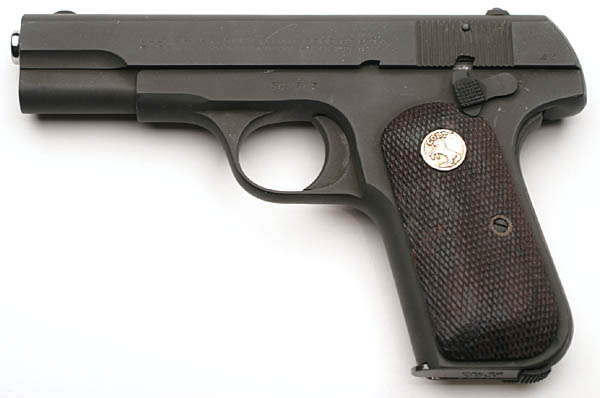
Colt Model M .32 ACP serial number 560567 - Military
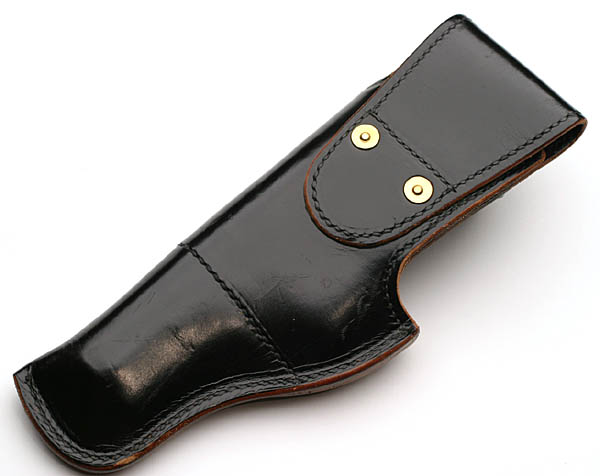
Model M .32 ACP pistol, originally a blued gun but arsenal
refinished in parkerized finish, with U.S. PROPERTY
mark on right side of frame and ordnance mark punch dot on
left front trigger guard bow. Pistol is documented as
having been issued to Brig. Gen. Kermit R. Hansen and is
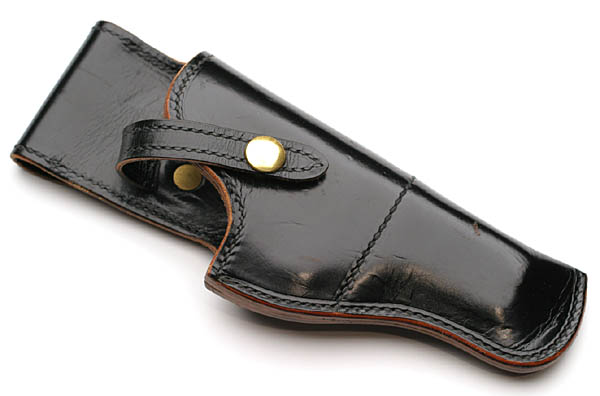
pictured with its original holster.
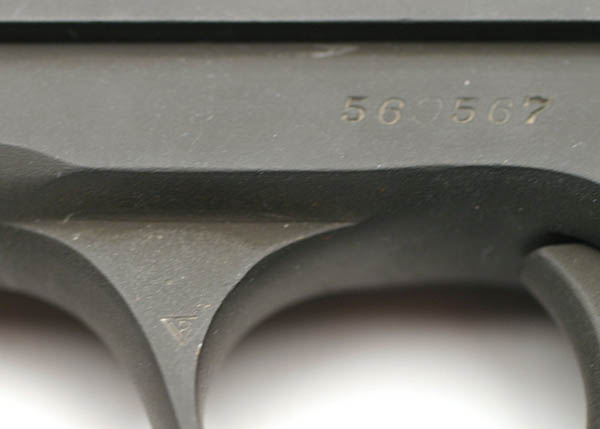
Serial number close-up. Also visible above the VP verified
proof mark is the "punch dot" ordnance mark.
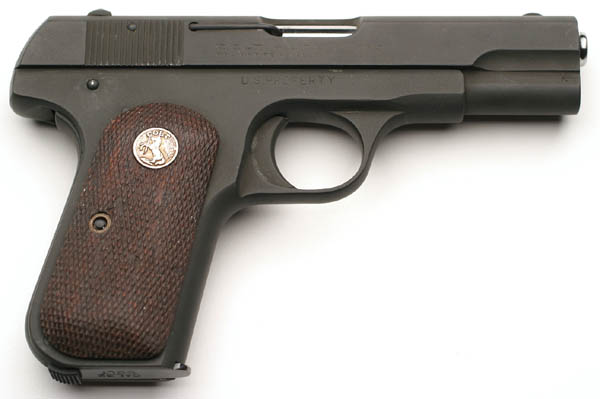
Colt Model M .32 ACP serial number 560567 - right
side
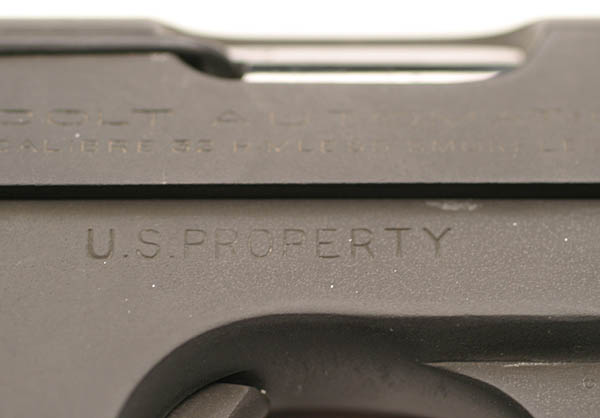
U.S. PROPERTY mark on right side of frame above the trigger.
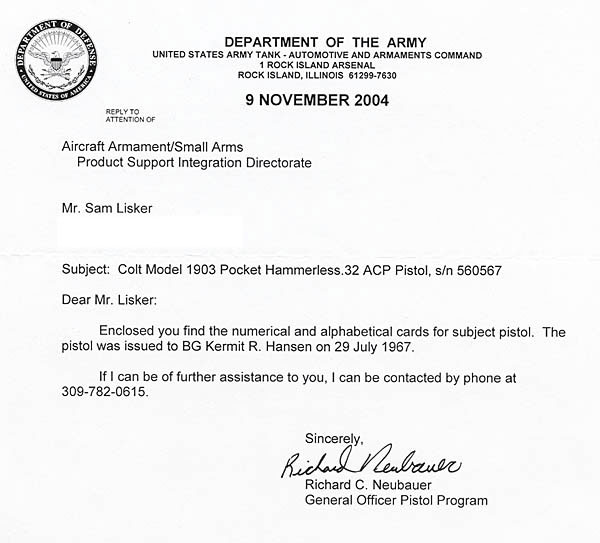
Rock Island Arsenal Historical Letter for Colt Model 1903
.32 ACP serial number 560567.
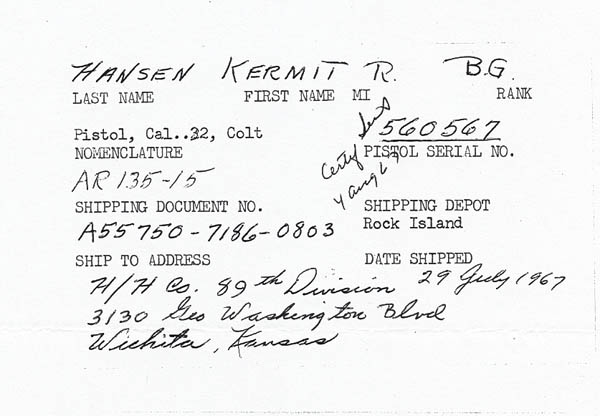
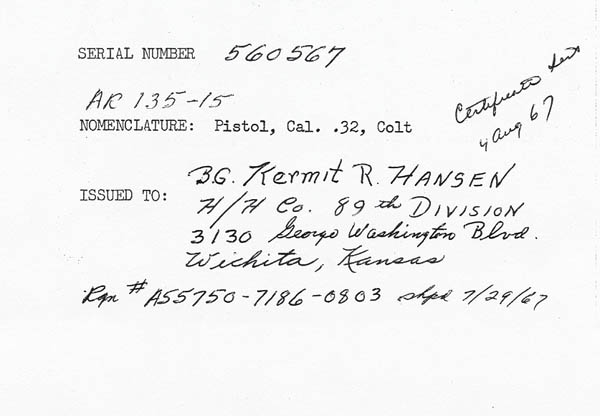
Copy of original index card from Rock Island Arsenal
documenting issue of "Pistol, Cal.. .32, Colt Serial Number
560567" to Brigadier General Kermit R. Hansen. Pistol was
shipped on 29 July 1967 to BG Kermit R. Hansen, H/H Co. 89th
Division, 3130 George Washington Blvd., Wichita, Kansas.
The Certificate of Ownership was sent on 4 August 1967.
| |
|
|
| 26 Feb 1917 |
|
Born, Omaha, Nebraska |
| 5
May 1939 |
|
2nd Lieutenant of
Infantry, Omaha, Nebraska |
| 19 August 1941 |
|
Active Duty, Omaha,
Nebraska |
| 1 September 1941 |
|
Training, Lake Charles,
Louisiana |
| 1 October 1941 |
|
Anti-tank Company,
168th Infantry, Camp Claiborne |
| 1 January 1942 |
|
Training, Fort Dix, New
Jersey |
| 19 February 1942 |
|
1st Lieutenant, Board
USS Neville (Transport) 16 ship convoy plus 10
destroyers |
| 2 March 1942 |
|
Company location,
Portstewant, Belfast, Ireland |
| 1 April 1942 |
|
British Jr. Officers
School |
| 14 August 1942 |
|
Captain |
| 1 November 1942 |
 |
North African Campaign,
29th Infantry Division, Algeria "While at Tidworth
the European Theater of Operations created a
provisional unit within the 29th Division, the 29th
Ranger Battalion. The Army's lone ranger battalion
recently demonstrated its worth in North Africa and
planners in London wanted a similar elite group in
England to prepare for the invasion of Europe. The
picked men learned specialized assault tactics by
training with British Commandos and detachments
accompanied their instructors on three hit-and-run
raids in Norway and in the English Channel. The 29th
Rangers also performed well in allied pre-invasion
exercises in England. A policy decision by the War
Department awarded the ranger mission to others,
forcing London to disband the battalion in October
1943. Fortunately for the Blue and Gray, the men
returned to their former units and passed on their
skills."
Source:
http://29thinfantrydivision.com |
| 1 January 1943 |
|
Aide de Camp to General
John Wilson O'Daniel, 5th Army Training |
| 14 March 1943 |
|
Major |
| 1 October 1943 |
 |
34th Infantry Division,
Sicily, Salerno, Anzio "Upon mobilization on
February 10, 1941, the 34th Division went into
intensive training at Camp Claiborne, Louisiana.
After the bombing of Pearl Harbor, the 34th Division
was chosen to be one of the first divisions sent
overseas. From Louisiana, the Division was sent to
Fort Dix, New Jersey, and then to Ireland for
additional training. In November of 1942, the 34th
took part in "Operation Torch," the Allied landing
on German occupied North Africa. The Division was
involved in numerous battles, such as Kasserine
Pass, Fondouk Pass, Faid Pass, as well as Allied
landings at Algiers and Tunis. By the time the
Germans surrendered at Tunis in May of 1943, many
brave men of the 34th had given their lives for
their country. In Italy, the men of the 34th, also
known as the Red Bull Division, were involved in the
battles of Naples, Anzio, Cassino, Rome-Arno, North
Apennines, and the Po Valley, where the U. S. 34th
Division captured the German 34th Division to end
the war in Italy.
During the course of World War II, the 34th
Division amassed 517 days of combat. One or more
34th Division units, including the 168th Regiment,
were engaged in actual combat for 611 days. The
Division was credited with more combat days than any
other division in the European theater. The 34th
Division suffered 21,362 battle casualties,
including 3,737 killed and 3,460 missing. The men of
the Division were honored with countless awards and
decorations, including 10 Medals of Honor and 15,000
Purple Hearts."
Source:
http://www.globalsecurity.org/military/agency/army/arng-ia.htm
|
| 1 August 1944 |
|
S-3, Operations &
Planning Officer of armored task force, Southern
France; Grenoble, France; Montelimar, France |
| 10 August 1944 |
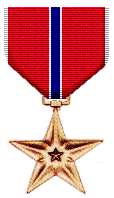 |
Bronze Star |
| 29 August 1944 |
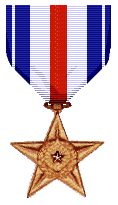 |
Silver Star |
| 1 September 1944 |

|
Battalion Commander:
7th Army, 36th Division, 141 Regiment, 3rd Battalion
MOSELLE BRIDGEHEAD
"The leading battalion, the 2nd of the 141st,
under Lt. Col. James Critchfield, moved downstream
on the near side of the river to a point opposite
the town of Eloyes which it was to attack as a
feint. The next battalion in column, the 1st, under
Lt. Col. Victor E. Sinclair, deployed and moved
toward the wooded banks of the river where it was to
cross. The last battalion, the 3rd, under Major
Kermit Hansen, got separated from the others and
reached the river about a mile and a half upstream
from the ford. With movement through the rough
terrain in pitchblack darkness extremely slow and
daylight about to break, Major Hansen decided that
he would have to cross where he was. He led a
platoon of I Company, commanded by Captain Roy F.
Sentilies, across the river by fording. As they
reached the other side and started to fan out they
were hit by the fire of eight heavy machine guns
centered on the shallows where the crossing had been
made. Captain Sentiles and several others were
killed, the, remainder of the platoon were wounded
and only four survived. Before he was taken, Major
Hansen managed to send word by radio to Move the
remainder of the battalion downstream to follow the
1st Battalion."
Source:
http://www.kwanah.com/txmilmus/36division/archives/moselle/moselle.htm
|
| 11 September 1944 |
|
Bronze Star Oak Leaf Clusters |
| 21 September 1944 |
|
Captured by Germans,
Vosage Mountains, France; orderly killed West of
Colmar on Moselle River. |
| 21 September 1944 |
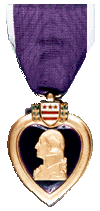 |
Purple Heart,
Remiremont, France |
| 14 October 1944 |
|
POW: West of Bydgoszez,
Oflag 64, Poland |
| 17 October 1944 |
|
Lt. Colonel |
| 21 January 1945 |
|
Began 43 day 350 mile
march to Germany (click for link to details)
Train to Hammelburg, Oflag 13B, Germany |
| 7 April 1945 |
|
7th Army frees prison
camp |
| 15 September 1945 |
|
Colonel |
| 5 March 1946 |
|
Discharge from Active
Duty
Active reservist |
| 6 December 1966 |
|
Brigadier General, 89th
Division |
| 26 February 1977 |
|
Retired from Army |
| 08 July 1999 |
|
Died Kermit Read
Hansen, American finance company executive.
Decorated Silver Star, Legion of Merit, Bronze Star
with two oak leaf clusters, Purple Heart, Combat
Infantry badge; recipient Safety award Nebraska
B'nai B'rith, 1964, Silver Beaver award Boy Scouts
American, 1965; named Man of Year Omaha Junior
Chamber of C., 1948, Omaha Order Eagles, 1949.
Kermit Hansen died July 8, 1999. He was initiated
as a University of Nebraska alumni member on
November 21, 1993. He received the Nebraska Chapter
Award of Merit in 1994. Mr. Hansen served on the
University of Nebraska Board of Regents for 20
years; he was appointed in 1970 and then elected in
1972, 1978, and 1984. He spent most of his career in
banking and was President and Chairman of U.S.
National Bank of Omaha. |

|
|
|